GoFreight Platform Overview: Software for Freight Forwarders (2026)


GoFreight Platform Overview: Software for Freight Forwarders
GoFreight is cloud-based, AI-powered freight forwarding software built specifically for freight forwarders and NVOCCs. The platform runs the full forwarder workflow on one system: rate management, quoting, booking, shipment operations, customs filing, customer portal, billing, and accounting. It is used by more than 1,000 forwarders across the United States, Mexico, and Asia-Pacific.
This page is a neutral overview of what GoFreight is, who uses it, what the platform includes, and how implementation works. If you are evaluating freight forwarding software in 2026, the goal here is to give you the facts you need before booking a demo, not a sales pitch. For a broader category comparison covering CargoWise, Magaya, Descartes, and other platforms, see our Best Freight Management Software 2026 guide.
Key Takeaways
- GoFreight is cloud-based, AI-powered freight forwarding software for ocean and air forwarders and NVOCCs. The same platform serves a 15-person regional forwarder and a multi-office global network.
- More than 1,000 forwarders are live on GoFreight, with coverage across 97 percent of US ports.
- Typical implementation runs 4 to 8 weeks, including configuration, data migration, training, and go-live.
- AI features are built into the base platform. Action Center, GoNexus Email Intake, and GoNexus Hub are included, not sold as add-on SKUs.
- Markets served: United States, Mexico, Greater China, Taiwan, Singapore, Indonesia, Vietnam, Malaysia, Thailand, and Cambodia. Multi-country and multi-office support is native to the platform.
What GoFreight Is
GoFreight is a freight forwarding management platform. It replaces the typical mix of legacy on-premise TMS, spreadsheets, shared inboxes, and bolt-on customs tools that many forwarders run today. Everything from the first rate request to the final invoice runs on one cloud platform.
Three things define how the product is built:
- Purpose-built for forwarders. Not a generic TMS bent toward shipper workflows. GoFreight handles HBL and MBL pairing, consolidation, agent settlement, and customs filing as first-class objects, not afterthoughts.
- Cloud-native and modern. Browser-based access. No on-premise servers. Staff in different offices or working from home use the same live system. The interface is designed for daily operational use, not for power-user training certifications.
- AI included in the base platform. Action Center, email intake, and document processing are part of the standard subscription, not separate paid modules.
Who Uses GoFreight
The current customer base spans regional forwarders through global enterprise networks. Common profiles include:
- Ocean and air freight forwarders moving FCL, LCL, and air cargo on a mix of customer-direct and agent-routed lanes.
- NVOCCs issuing their own House Bills of Lading and managing consolidation across multiple shippers per container.
- Customs brokers and forwarder-brokers filing AES, ISF, and AMS for US shipments.
- Multi-country networks running back office operations in lower-cost markets (Vietnam, Philippines, Indonesia, Cambodia) on the same live platform as the front office.
“GoFreight is my first choice because it's a perfect package.
Rebecca Zhang, CEO, TG Cargo Inc.
Platform Modules
The platform is organized into modules that share one underlying shipment record. Data entered in one module flows through the rest without re-entry.
Rate Management and Quoting
Centralized rate database for contract rates and spot rates. Multi-currency support. Quote templates and version history. AI reads contract rates, combines them with spot rates and vessel schedules, and turns them into customer-ready quotes. Accepted quotes convert into shipment records with all data intact. For more on this module, see Rate Management Quoting Software for Forwarders.
Shipment Operations
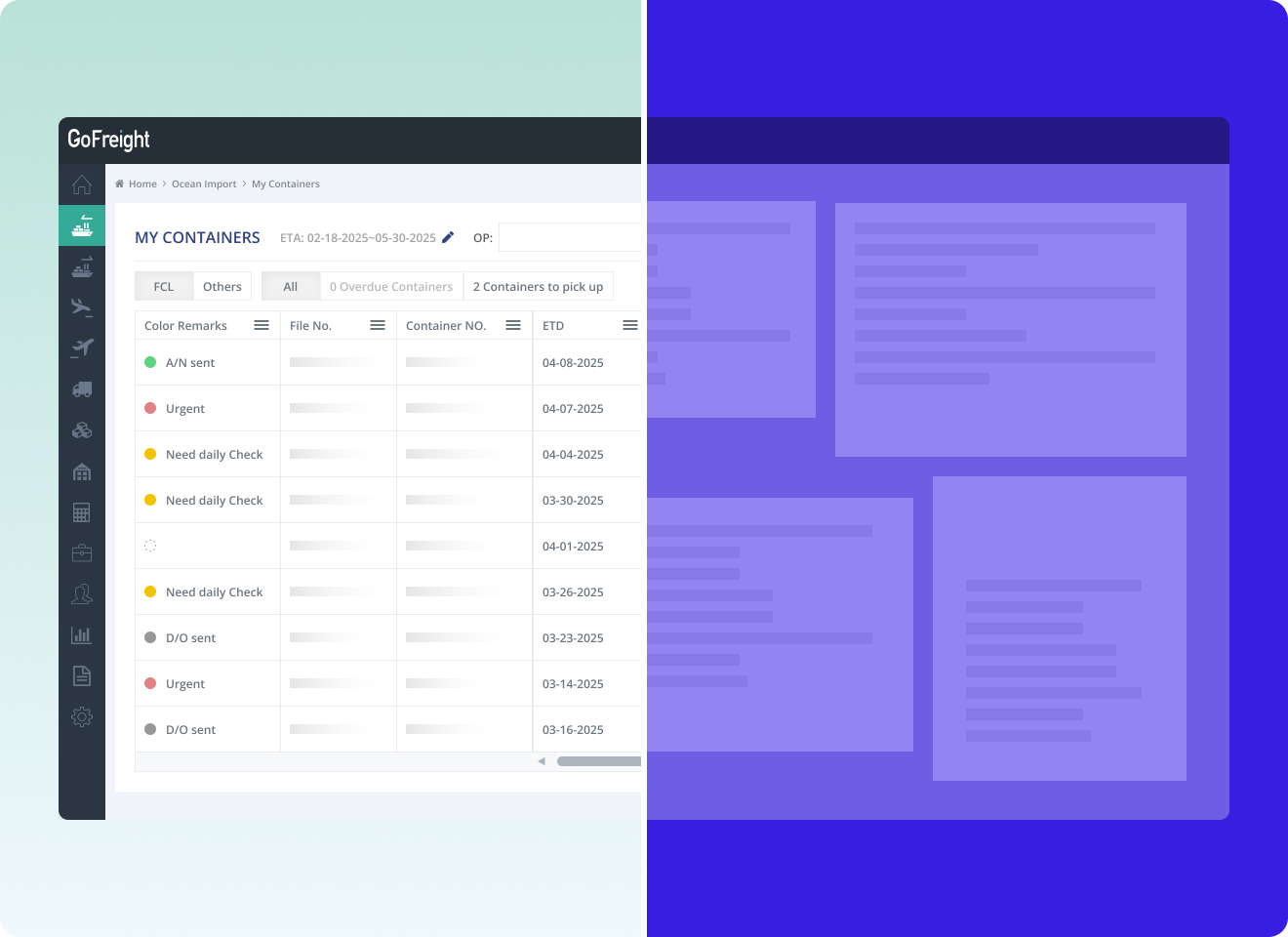
Full ocean and air shipment handling. FCL, LCL, and consolidation workflows. House and Master Bill pairing. Documentation generation (HBL, arrival notice, commercial invoice, packing list, delivery order). Container lifecycle tracking from gate-in through empty return.
Tracking and Visibility
Carrier integrations covering major ocean lines (MSC, Maersk, CMA CGM, COSCO, and others) and air carriers. Real-time milestone updates flow into the shipment record. Demurrage and detention free-time alerts surface before fees accrue. For more on the operations workflow, see Shipment Tracking & Operations Software for Forwarders.
Customer Portal
Branded self-service portal where each customer sees only their own shipments, documents, quotes, and invoices. Reduces email volume from "where is my container?" questions. CO2 visibility is available per shipment. Learn more at Customer Portal Software for Forwarders.
Customs Filing
Native AES filing for US ocean and air exports, ISF for US ocean imports, AMS for US ocean imports, and AFR JP24 filing for air cargo entering Japan. e-AWB data submission to airlines via EDI. No separate broker tool required for the core US filings.
Billing and Accounting
Per-shipment invoicing, batch invoicing, agent settlement, multi-currency reconciliation, and P&L by shipment. Two-way integrations with QuickBooks, Xero, and other accounting platforms keep external books in sync. For details, see Freight Billing & Accounting Software for Forwarders.
Analytics
Reporting and KPI dashboards covering shipment volume, margin per shipment, customer profitability, and operations productivity. Built on the same live data as the rest of the platform, so reports do not lag the operational record.
AI Features
AI in GoFreight is not a separate add-on tier. The following are part of the standard platform:
- Action Center. Task management with natural language prompts. Staff can ask the system to find shipments matching specific conditions, surface overdue items, or trigger follow-up actions.
- GoNexus Email Intake. Reads inbound customer and carrier emails, extracts shipment information, and either creates new shipment records or updates existing ones. Reduces manual data entry from shared inboxes.
- GoNexus Hub. Drag-and-drop document processing with AI data extraction. Upload a commercial invoice, packing list, or booking confirmation; the system reads it and writes structured data into the shipment record.
- AI Rate Management. Reads contract rates from carrier sheets, combines with spot rates and vessel schedules, and generates customer quotes ready for review.
“Switching to GoFreight was a game-changer. I save at least 50% of my time.
Jason Hsu, Owner, Whale US
Markets and Coverage
GoFreight operates across ten markets in North America and Asia-Pacific:
| Region | Markets Served | Common Use |
|---|---|---|
| North America | United States, Mexico | US-based forwarders and NVOCCs with cross-border Mexico lanes; 97 percent US port coverage |
| Greater China | Mainland China, Taiwan, Hong Kong | Origin offices coordinating US-bound and Europe-bound exports |
| Southeast Asia | Singapore, Indonesia, Vietnam, Malaysia, Thailand, Cambodia | Regional hubs and back office teams operating on the same live platform as the front office |
Multi-country and multi-office support is native to the platform. A forwarder with a US headquarters, a Vietnam back office, and a Mexico branch can run all three on one tenant with role-based access by office.
Implementation
Typical implementation runs 4 to 8 weeks for a mid-market forwarder. For comparison, legacy enterprise platforms typically take 6 to 12 months and require dedicated internal IT.
-
1Configuration (week 1 to 2)Tenant setup, office and user structure, accounting code mapping, document templates, customer and partner records imported from the existing system.
-
2Data migration (week 2 to 4)Rate agreements, open shipments, and selective historical data brought across. Established migration paths exist from CargoWise, Magaya, Descartes, and in-house systems.
-
3Training (week 3 to 5)Role-based sessions for operations, sales, accounting, and management. Practice tenant available for hands-on use. Most staff are productive within days, not weeks.
-
4Go-live and support (week 5 to 8)Parallel run period, then full cutover. Dedicated Customer Success Manager assigned for ongoing optimization. 24-hour email support, help center, and tutorials available throughout.
“Onboarding was simple, and the platform is easy to use.
Dipty Jardosh, Operations Director, GC Logistics
Pricing
GoFreight uses per-user subscription pricing with features included rather than separate per-module SKUs or per-transaction surcharges. Pricing varies by user count and specific requirements and is quoted during the demo process.
What is in the base subscription:
- Core platform: rate management, quoting, booking, shipment operations, documentation, customer portal, billing, and accounting.
- AI features: Action Center, GoNexus Email Intake, GoNexus Hub, and AI Rate Management.
- Carrier and customs integrations covering ocean lines, air carriers, and US filings.
- Implementation, training, and Customer Success Manager.
This pricing model is the main alternative to the per-shipment Value Pack pricing that CargoWise moved to in December 2025, which has driven reported 20 to 50 percent cost increases for many customers. For background, see our coverage of CargoWise Pricing 2026: Understanding the New Value Pack Model.
Per-user and per-shipment pricing models are not interchangeable. Per-shipment pricing can appear cheaper at low volumes and rapidly compound as shipment count grows. Always model 3-year total cost of ownership against your actual shipment volume and headcount before committing to any platform.
Integrations
GoFreight connects to the systems forwarders already use rather than asking them to replace everything:
- Ocean carriers. Direct integrations with MSC, Maersk, CMA CGM, COSCO, and other major lines for tracking and booking data.
- Air carriers. e-AWB data exchange via EDI.
- Customs systems. ABI for US filings (AES, ISF, AMS) and AFR for Japan.
- Accounting. Two-way QuickBooks, Xero, Sage, and other accounting platform sync.
- API. REST API available for customer ERP integrations and custom internal tools.
For details on what is integrated and how new connections are added, see Freight Integrations Software for Forwarders.
Customer Outcomes
The outcomes below come from forwarders that publicly shared their results after switching to GoFreight. Your numbers will depend on your starting point and operational mix.
| Forwarder | Reported Outcome |
|---|---|
| Whale US | 50 percent time savings on daily operations |
| Headwin Global Logistics | From 100 shipments per month to 200 with the same team |
| UCM | 53 percent reduction in detention and demurrage costs |
| Allround Forwarding Midwest | Faster quoting and shipment turnaround after switching from a legacy system |
“I tried 7 different systems before GoFreight. GoFreight is very user friendly, and I am quick in the system.
Janko Wille, CEO, Allround Forwarding Midwest
How GoFreight Compares
Forwarders evaluating GoFreight usually compare it to three other categories of software:
- Legacy enterprise platforms. Typically deeper functionality in some niche areas, but 6 to 12 month implementations, dedicated IT requirements, and per-shipment pricing that scales with volume.
- Older mid-market platforms. Often bundle a strong warehouse module but have older interfaces and limited AI tooling. Implementation runs 8 to 12 weeks.
- Generic TMS or in-house spreadsheets. Cheap or free at the start, but missing HBL and MBL handling, agent settlement, customs filing, and customer portal. Operational drag compounds as volume grows.
For head-to-head detail, see CargoWise vs GoFreight: Honest Comparison.
Frequently Asked Questions
What is GoFreight?
GoFreight is cloud-based, AI-powered freight forwarding software built specifically for freight forwarders and NVOCCs. The platform runs the full forwarder workflow on one system: rate management, quoting, booking, shipment operations, customs filing, customer portal, billing, and accounting. It is used by more than 1,000 forwarders across the United States, Mexico, and Asia-Pacific.
Who uses GoFreight?
GoFreight is used by ocean and air freight forwarders, NVOCCs, and forwarder-brokers ranging from regional offices of 15 staff through global enterprise networks. Common profiles include US forwarders running ocean import and export lanes, Asia-Pacific origin offices coordinating exports, and multi-country networks with back office teams in lower-cost markets working on the same live platform as the front office.
What markets does GoFreight serve?
GoFreight serves the United States, Mexico, Greater China, Taiwan, Singapore, Indonesia, Vietnam, Malaysia, Thailand, and Cambodia. Multi-country and multi-office support is native to the platform, so one tenant can run offices in several markets with role-based access by office.
How long does GoFreight implementation take?
Typical implementation runs 4 to 8 weeks for a mid-market forwarder. The four phases are configuration (week 1 to 2), data migration (week 2 to 4), training (week 3 to 5), and go-live and support (week 5 to 8). Established migration paths exist from CargoWise, Magaya, Descartes, and in-house systems.
What does GoFreight cost?
GoFreight uses per-user subscription pricing with features included rather than separate per-module SKUs or per-transaction surcharges. Pricing varies by user count and specific requirements and is quoted during the demo process. Implementation, training, and Customer Success Manager support are part of the standard package, not separate paid add-ons.
What integrations does GoFreight support?
GoFreight integrates with major ocean carriers (MSC, Maersk, CMA CGM, COSCO, and others), air carriers via e-AWB EDI, US customs filing systems (AES, ISF, AMS via ABI), Japan air customs (AFR JP24), and accounting platforms including QuickBooks, Xero, and Sage with two-way sync. A REST API is available for ERP integrations and custom internal tools.
What AI features does GoFreight include?
GoFreight includes Action Center (task management with natural language prompts), GoNexus Email Intake (inbox-to-shipment automation), GoNexus Hub (drag-and-drop document processing with AI data extraction), and AI Rate Management (reads contract rates and combines with spot rates and vessel schedules to generate quotes). All four are part of the base subscription, not separate paid add-ons.
Does GoFreight handle customs filing?
Yes. GoFreight files AES for US exports, ISF and AMS for US ocean imports, and AFR JP24 for air cargo entering Japan. e-AWB data is submitted to airlines via EDI. The filings happen inside the same shipment record, so there is no separate broker tool or re-entry of data.
How does GoFreight compare to CargoWise and Magaya?
GoFreight is cloud-native with 4 to 8 week implementation and AI features included in the base subscription. CargoWise has the deepest enterprise functionality but typically requires 6 to 12 months to implement and uses per-shipment Value Pack pricing introduced in December 2025. Magaya is mid-market with a strong warehouse module and 8 to 12 week implementation. Most forwarders evaluate based on operating model, IT capacity, and 3-year total cost of ownership rather than feature count alone.
Ship Faster. Scale Smarter.
See the platform run your actual workflow. Rate management, quoting, operations, customs filing, customer portal, and accounting on one cloud system.