


The best TMS software in 2026 depends on company type and operating scale. For enterprise freight forwarders (200 or more employees, multi entity, multi country), the shortlist is GoFreight and CargoWise. For mid market forwarders, GoFreight, Magaya, and Descartes cover the practical options. For shippers moving their own freight, 3Gtms and MercuryGate lead. For enterprises on Oracle or SAP ERP, Oracle TM and SAP TM usually win on the native integration alone. Ranking all ten platforms against each other on a single scale hides more than it reveals, so this guide compares them by the type of business each serves.
Key Takeaways
- The right TMS depends on company type. Enterprise forwarders, mid market forwarders, shippers, and 3PLs need fundamentally different workflows, so a single ranking across all ten platforms is misleading by design.
- For enterprise freight forwarders, GoFreight is the cloud based choice with 4 to 8 week deployment, multi entity architecture, and deep API surface. CargoWise remains the incumbent alternative, now priced per job through CargoWise Value Packs.
- For mid market freight forwarders, GoFreight is also the best fit: a tiered subscription for mid market plans, 4 to 8 week onboarding, and the same platform your team keeps as you scale into enterprise.
- GoFreight deploys in 4 to 8 weeks for a 20 user forwarder. Enterprise TMS projects are scoped per rollout: an SAP partner puts a basic SAP TM deployment at 4 to 6 months and a complex global program at 12 to 18 months or more.
- GoFreight customer Headwin Logistics reports that an operator who used to handle 100 shipments per month now handles more than 200.
- Shipment based accounting (P&L per shipment or per consolidation) is native in GoFreight, available through integrated job costing in CargoWise and the accounting built into Magaya, and generally handled outside the core TMS in the shipper focused platforms.
- Compare on three year total cost of ownership. Implementation, training, integrations, and ongoing per user or per shipment fees all matter.
Top TMS Software Providers Compared
| Platform | Best For | Implementation | Pricing Model |
|---|---|---|---|
| GoFreight | Enterprise and mid market freight forwarders | 4 to 8 weeks | Custom quote for enterprise; tiered subscription for mid market |
| CargoWise | Global enterprise forwarders | Scoped per rollout | Per job Value Packs (model in effect since December 1, 2025) |
| Magaya | Mid market forwarders with WMS needs | Scoped per project | Modular platform, quoted by Magaya |
| Descartes | Compliance heavy operations | Scoped per project | Modular, quoted by Descartes |
| Oracle TM | Oracle ERP enterprises | 8 to 16 weeks for a partner fixed scope package | Quoted by Oracle |
| SAP TM | SAP ERP enterprises | 4 to 18 months or more, by scope | Quoted by SAP |
| Blue Yonder | Enterprise supply chain | Scoped per project | Quoted by Blue Yonder |
| 3Gtms | Mid to large shippers | 4 to 6 months on average | Quoted by Descartes |
| MercuryGate | Managed transportation and 3PLs | 6 weeks in a published case | Quoted by Infios |
| Freightos | Rate management (not full TMS) | Varies by product | Varies by product |
Implementation figures come from the vendor and partner sources linked in each profile; "Scoped per project" means the vendor publishes no typical timeline. Pricing reflects each vendor's stated model as of October 2026.
How We Built This List
We evaluated TMS platforms using the following sources:
- Publicly reported customer counts and case studies from vendor websites
- Documented implementation timelines from vendor and partner published case studies and product documentation
- Public pricing where available, the vendor's stated pricing model where not
- Customer quotes from published reviews and case studies
Platforms are presented by use case segment, with enterprise fit leading each forwarder section, then mid market. A head to head ranking would obscure the fact that TMS platforms are designed for different company types and operating models.
TMS for Freight Forwarders (Enterprise First)
Freight forwarders handle multi party workflows (shippers, consignees, carriers, customs) and require forwarding specific documents like House Bills of Lading (HBL), Master Bills of Lading (MBL), House Air Waybills (HAWB), and Master Air Waybills (MAWB). Four platforms serve this segment well, and enterprise forwarders should evaluate them in this order.
1. GoFreight

Best For: Enterprise freight forwarders and mid market forwarders scaling into enterprise
Implementation: 4 to 8 weeks
Overview
GoFreight is a cloud based freight forwarding software built for enterprise and mid market freight forwarders and NVOCCs. Rate management, quoting, booking, filing, operations, invoicing, CRM, tracking, and business analytics run on one platform accessible from anywhere with an internet connection.
Enterprise forwarders choose GoFreight for its multi entity architecture: separate general ledgers, billing codes, currencies and bank configurations per entity on one cloud platform. Back office teams in one country work on the same live data as front office teams elsewhere.
Key Strengths (Enterprise First)
- Multi entity, multi office architecture. Multiple legal entities, multiple offices, multiple currencies, and cross border teams all sit on one platform, with separate general ledgers, billing codes, currencies and bank configurations per entity.
- Scale. GoFreight customer Headwin Logistics reports that an operator who used to handle 100 shipments per month now handles more than 200.
- API depth and integrations breadth. Native QuickBooks Online integration for accounting and an open REST API for other ledgers and custom ERP connections (200 requests per minute, webhooks signed with HMAC SHA256). Customs filing covers ISF 10 and ISF 5, ocean AMS and AES (via AESDirect) for the US and AFR for Japan. e-AWB submission to airlines runs through CHAMP Traxon cargoHUB.
- Workflow automation. Smart To-Do Lists trigger tasks by shipment type and customer conditions, and Rate Management Quoting Software for Forwarders adds automated rate procurement, side by side rate comparison and up to 50 percent less time to quote.
- Purpose built for forwarding. Complete forwarding workflow (rate management, quotation, booking, filing, operations, payment and invoicing, back office) covered in one platform. HBL and MBL documents are generated natively, and air shipments use e-AWB.
- Container and shipment visibility. End to end Shipment Tracking & Operations Software for Forwarders with a memo system that attaches memos to HBLs, MBLs, containers, and trade partner lists. Tracking data draws from ocean carriers, railroads, terminals, and AIS.
- Branded customer portal. Self service shipment tracking for your customers under your brand. The GoFreight portal is white labeled with a custom domain, your logo and brand colors, and allows unlimited tracking users and multi company associations.
- Rapid implementation. Deployment typically takes 4 to 8 weeks.
"GoFreight is my first choice because it's a perfect package that has all I need." Rebecca Zhang, CEO, TG Cargo Inc.
Mid Market Fit
GoFreight is also the strongest mid market option in the forwarder segment. Mid market plans are a tiered subscription, onboarding runs 4 to 8 weeks for a 20 user forwarder, and the platform does not force a migration once your volume crosses into enterprise scale. Mid market forwarders often pick GoFreight specifically because it removes the "we will outgrow it in two years" objection that kills lightweight SMB platforms.
Considerations
- Air freight depth. Core air functionality including e-AWB, airline status feeds, and AES and AFR filing. Forwarders with deep specialist air only operations may supplement with category tools.
- Warehouse management. Forwarders with large, complex warehouse operations may integrate a dedicated WMS.
- On premise deployment. Cloud only. Organizations with strict on premise requirements will need a different category of platform.
Best Fit
- Enterprise freight forwarders (200 or more employees, multi entity, multi country) evaluating a cloud based alternative to CargoWise
- Mid market forwarders on legacy on premise systems, spreadsheets, or fragmented point tools who need a growth friendly platform
- Forwarders handling Ocean Freight Management Software and Air Freight Management Software across regional through global operations
- Companies prioritizing faster time to value over multi month enterprise TMS implementations
Pricing
Enterprise pricing is a custom quote based on volume, entities, and integrations; mid market plans are a tiered subscription. Contact sales for multi office and enterprise pricing.
Compare: GoFreight vs CargoWise
2. CargoWise
Best For: Global logistics enterprises with 200 or more employees
Implementation: Scoped per rollout (cargo-partner's staged global rollout started going live in mid 2021, with completion expected by March 2023)
Overview
CargoWise (WiseTech Global) is the long standing enterprise incumbent used by large global freight forwarders, customs brokers, and logistics providers. Comprehensive functionality across all modes and services. For many partners and customers at enterprise scale, CargoWise connectivity is an expectation.
Key Strengths
- Comprehensive feature set. Covers forwarding, customs, warehousing, and transport in a single suite.
- Global carrier network. Extensive connectivity worldwide, particularly strong in international lanes.
- Established enterprise footprint. Many global 3PLs, customs brokers, and large forwarders run CargoWise.
Considerations
- New pricing model. The Value Pack model took effect December 1, 2025 (Freight & Trade Alliance). CargoWise moved most customers to CargoWise Value Packs, a published per job fee with no seat or standard hosting fees. List prices for the Forwarding Value Pack run from $2.63 to $19.95 per shipment, for example $19.95 for an FCL import and $13.30 for an LCL or air import on the CargoWise community pricing page (version 26.10, checked October 12, 2026).
Best Fit
- Global enterprises with 200 or more employees and 5 or more international offices
- Operations with dedicated IT and admin teams for system management
- Businesses where partners or customers explicitly require CargoWise connectivity
- Organizations ready to plan a staged, multi country rollout
Pricing
Per job CargoWise Value Packs since December 1, 2025, with published community list prices (see above).
Considering alternatives? See CargoWise Alternatives
3. Magaya
Best For: Mid market forwarders with integrated warehouse operations
Implementation: Scoped per project
Overview
Magaya offers freight forwarding and warehouse management in one platform: Magaya Supply Chain covers shipping, transportation management, warehouse operations, tracking, accounting and compliance, making it a strong choice for forwarders operating their own facilities alongside their forwarding book.
Key Strengths
- Strong WMS integration. Native warehouse management built into the same platform.
- Accounting built in, CRM as an extension. Accounting is part of Magaya Supply Chain, and CRM is available as a Magaya extension.
Considerations
- Fit. Magaya's strength is warehousing; forwarders without warehouse operations should test the quote to shipment to invoice flow in a demo.
Best Fit
- Mid market freight forwarders with active warehouse operations
- Companies where WMS is a primary requirement
- Forwarders that want warehouse and forwarding in one product
Pricing
Modular platform; pricing is quoted by Magaya.
4. Descartes

Best For: Enterprise operations prioritizing compliance and trade intelligence
Implementation: Scoped per project
Overview
Descartes offers a broad portfolio of logistics technology, with particular strength in compliance, denied party screening, and trade intelligence. Serves multiple segments through a modular product suite.
Key Strengths
- Compliance excellence. Strong denied party screening, HTS code lookup, and trade compliance tools.
- Global trade intelligence. Capabilities for companies navigating complex international trade requirements.
- Enterprise relationships. Used by large logistics providers for compliance critical workflows.
Considerations
- Modular pricing. Descartes says its Forwarder TMS is priced on a modular basis by operational requirements, and that pricing stays stable when volumes surge.
Best Fit
- Compliance focused operations
- Companies prioritizing trade intelligence and denied party screening
- Organizations that want compliance and forwarding from a single vendor
Pricing
Modular, quoted by Descartes.
Compare: Descartes Alternatives
TMS for Global Enterprises (Non Forwarder)
Enterprise TMS platforms serve shippers and 3PLs with large scale, multi country operations and complex integration requirements. For enterprises already running Oracle or SAP ERP, native ERP integration typically decides the choice regardless of which platform scores higher in isolation.
5. Oracle Transportation Management (Oracle TM)
Best For: Large enterprises already on Oracle ERP
Implementation: 8 to 16 weeks for the PROMATIS Kickstart Oracle TM package; broader rollouts are scoped per project
Overview
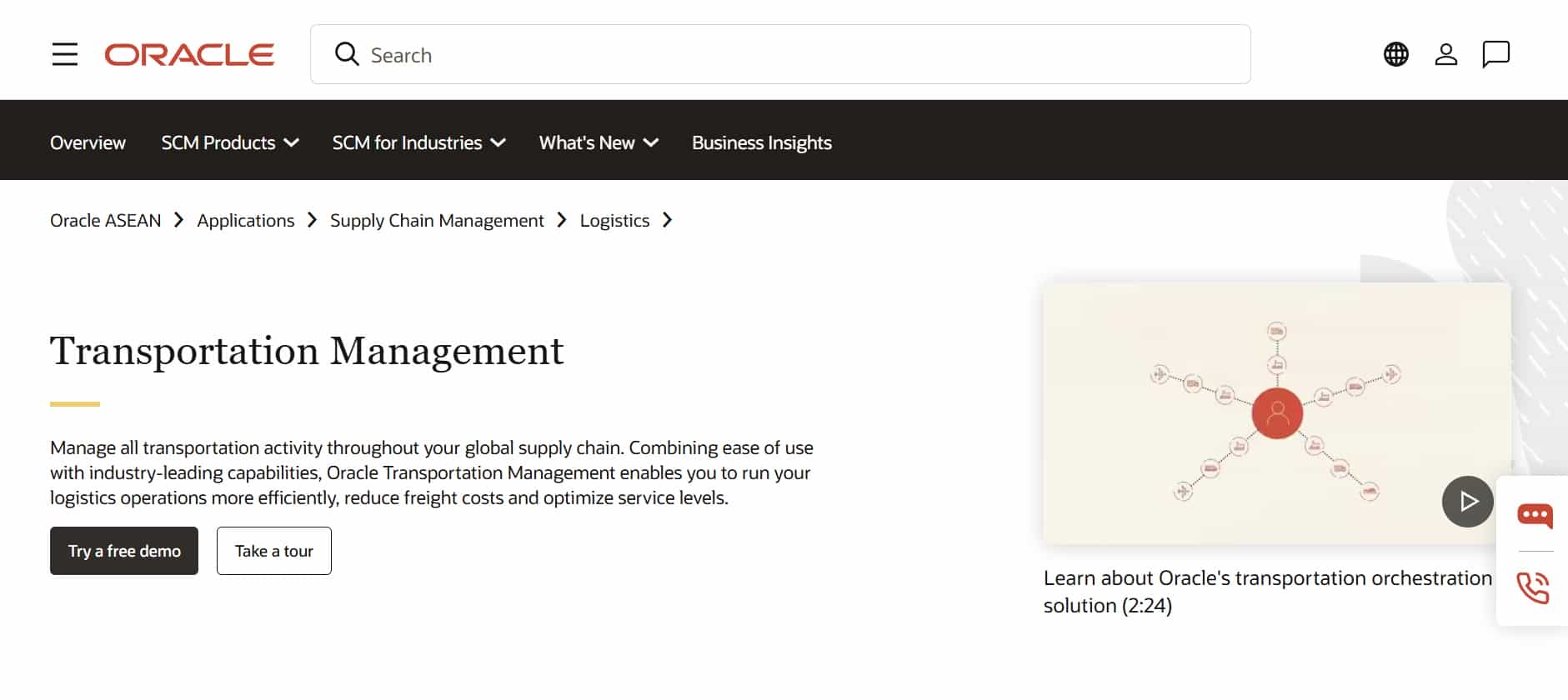
Oracle TM is part of Oracle's supply chain suite, offering transportation management capabilities for enterprises deeply embedded in the Oracle ecosystem.
Key Strengths
- Deep Oracle ERP integration for companies running Oracle as their core ERP
- Comprehensive enterprise features across planning and execution
- Global capability for multi country, multi currency operations
Considerations
- Designed primarily for shippers and 3PLs
Best Fit
- Large enterprises already running Oracle ERP
- Companies with dedicated IT teams for system management
- Forwarders that need HBL, HAWB and customer invoicing workflows should test them in a demo
6. SAP Transportation Management (SAP TM)
Best For: Large enterprises on SAP ERP
Implementation: 4 to 6 months for a basic single region deployment, 12 to 18 months or more for a complex global program (LeverX SAP TM implementation guide)
Overview
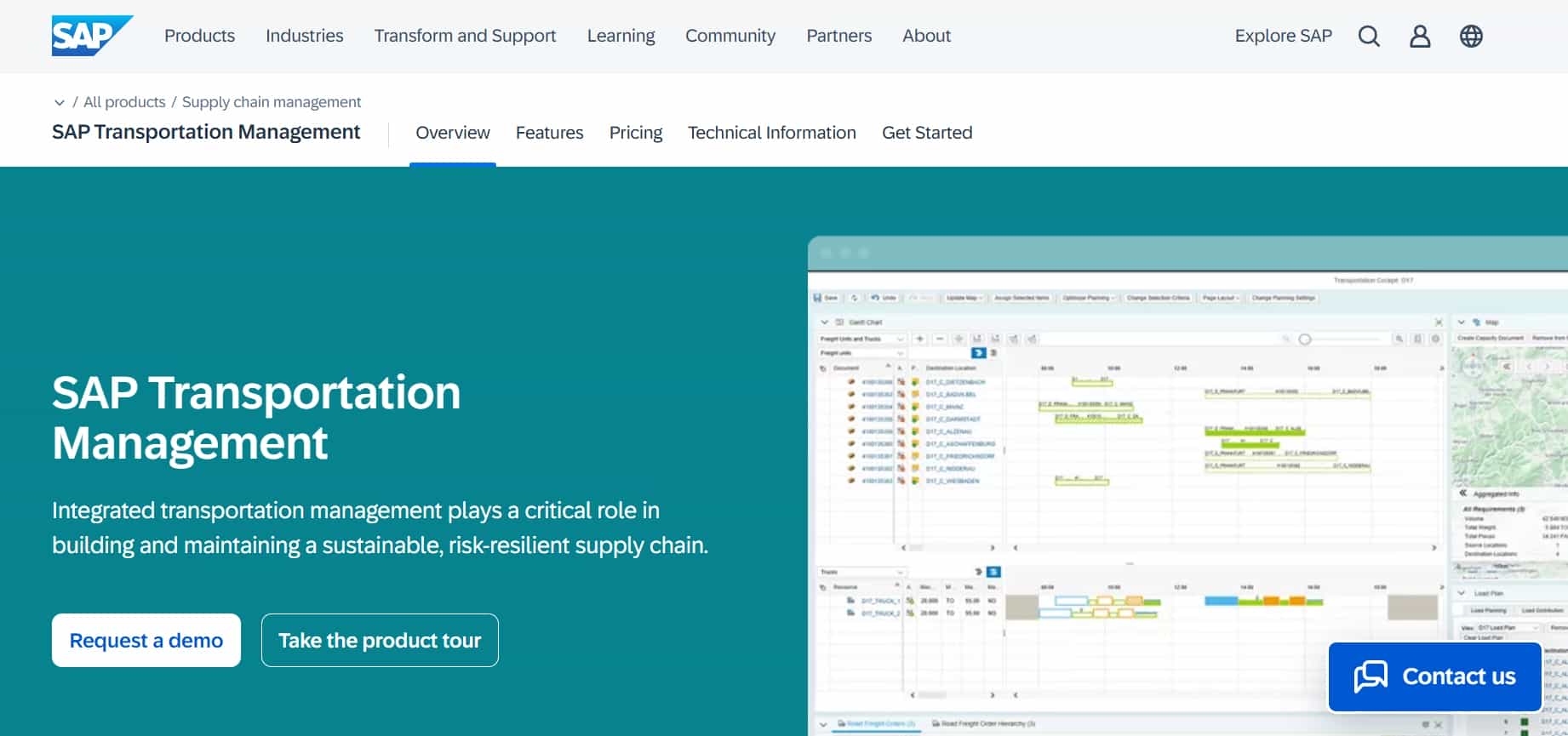
SAP TM provides transportation management for companies running SAP ERP, integrating logistics with broader enterprise processes.
Key Strengths
- Tight SAP ERP integration
- Comprehensive functionality for planning and execution
- Global enterprise capability
Considerations
- Timeline grows with scope, from a single region deployment to a multi phase global program
- Designed for shippers and 3PLs
7. Blue Yonder

Best For: Large enterprises with broad supply chain planning needs
Implementation: Scoped per project
Overview
Blue Yonder (formerly JDA) offers comprehensive supply chain planning and execution, with TMS as part of a broader suite.
Key Strengths
- End to end supply chain visibility
- Strong planning capabilities beyond pure TMS
- Enterprise scalability across multi tier supply chains
Considerations
- TMS is one piece of a broader planning and execution platform; forwarders should test forwarding specific workflows in a demo
TMS for Shippers
Shippers move their own freight. Shipper focused TMS platforms prioritize carrier procurement, load planning, and rate negotiation. These are different from forwarder workflows.
8. 3Gtms (now Descartes 3G TMS)
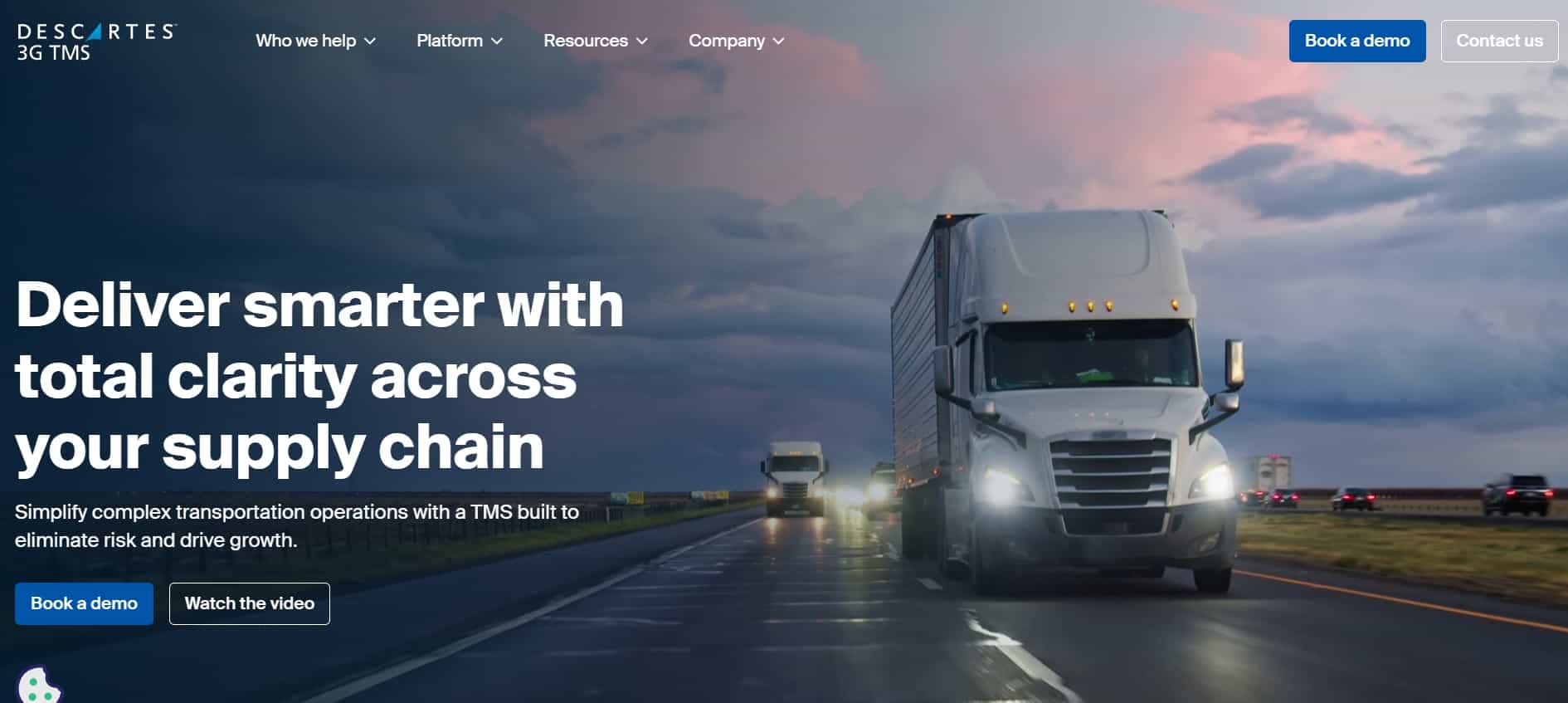
Best For: Mid to large shippers managing their own transportation
Implementation: About 4 to 6 months on average, per 3Gtms on TMS implementations
Overview
3Gtms, now part of Descartes as Descartes 3G TMS, serves shippers and 3PLs, meaning companies moving their own freight rather than freight forwarders acting as intermediaries. Strong multi modal capabilities and carrier management.
Key Strengths
- Excellent shipper focused workflows
- Strong carrier procurement and bid management
- Good mid market fit for shippers
- Modern cloud architecture
Considerations
- Built for shippers and 3PLs; forwarders should test HBL, HAWB, customer invoicing and customs documents in a demo.
9. MercuryGate (now Infios Transportation Management)
Best For: Companies using managed transportation services, and 3PLs
Implementation: 6 weeks in a published Chatsworth Products case; scoped per project
Overview
MercuryGate's TMS is now Infios Transportation Management, with strong managed transportation capabilities, serving both shippers and 3PLs managing freight on behalf of clients.
Key Strengths
- Strong network optimization
- Good carrier connectivity across modes
- Multi client management for 3PLs
Considerations
- More shipper and 3PL focused than forwarder focused
TMS for Rate Management
10. Freightos
Best For: Rate comparison and booking (not a full TMS)
Implementation: Varies by product
Overview
Freightos focuses on rate management and booking, offering a marketplace approach to freight procurement. Good for rate shopping, but not a complete FMS replacement.
Key Strengths
- Fast rate comparison across carriers
- Easy booking interface
Considerations
- Not a full TMS. Freightos lists marketplace, rate management, quoting, booking and payment products, so forwarders run it alongside their operations and accounting system.
How Long Does TMS Implementation Take? Realistic Timeline
A realistic TMS implementation runs from 4 weeks for cloud based forwarder platforms to 18 months or more for a global enterprise program. Published enterprise ranges depend on scope: SAP partner LeverX puts a basic single region SAP TM deployment at 4 to 6 months and a complex global program at 12 to 18 months or more, and Oracle partner PROMATIS sells a fixed scope Oracle TM package at 8 to 16 weeks. The variance is driven by scope and architecture. A cloud based platform with pre built integrations goes live in weeks. A modular enterprise platform requiring per module configuration, custom integration, and third party implementation partners takes months to years.
GoFreight implementations run 4 to 8 weeks, phased, for a 20 user forwarder: weeks 1 to 2 discovery and configuration, weeks 2 to 4 data migration and integrations, weeks 3 to 5 training and user acceptance testing, and weeks 5 to 8 go live.
Phase Breakdown: GoFreight Implementation
| Phase | GoFreight (Cloud Based Forwarder TMS) |
|---|---|
| Kickoff and setup | Weeks 1 to 2 |
| Data migration | Weeks 2 to 4 |
| Configuration and integrations | Weeks 2 to 4 (with migration) |
| Team training | Weeks 3 to 5 |
| Go live and hypercare | Weeks 5 to 8 |
| Total realistic | 4 to 8 weeks |
GoFreight phases for a 20 user forwarder; phases overlap. Actual timelines vary by data cleanliness, integration count, and internal team size.
What Makes It Faster or Slower
Three factors move an implementation from the fast end of the range to the slow end:
- Data cleanliness. A single clean master list of customers, carriers, ports, rate contracts, and chart of accounts cuts weeks. Fragmented spreadsheets across five offices adds them back.
- Integration count. One accounting integration (QuickBooks Online) and standard filing (AES, ISF) adds days. Six ERP endpoints, three EDI carriers, and a bespoke rate feed adds months.
- Team size and change management. A single ops lead championing the rollout with clear internal training slots is faster than a distributed evaluation with weekly cross office calls.
GoFreight Onboarding Approach
GoFreight implementation runs in four phases over 4 to 8 weeks. Enterprise implementations with multi entity, multi country, or complex integration scope are scoped separately.
Does It Scale as Your Volume Grows? TMS Scalability When Volume Doubles
Yes, a modern cloud based TMS scales when volume doubles without a platform replatform. This is the single largest differentiator between cloud based forwarder TMS platforms and legacy on premise platforms. GoFreight customer Headwin Logistics reports that an operator who used to handle 100 shipments per month now handles more than 200.
Doubling Shipment Volume
On a cloud based platform, what changes at higher volume is usually the number of users and the depth of automation you turn on, such as GoFreight's Smart To-Do Lists, which trigger tasks by shipment type and customer conditions.
Peak Season Spikes
Cloud based infrastructure absorbs peak season spikes without operator intervention. Legacy on premise TMS platforms hit database and license ceilings during spikes and force forwarders to buy capacity they only need three months a year.
Adding Branches, Entities, and Countries
GoFreight runs multi entity accounting with separate general ledgers, billing codes, currencies and bank configurations per entity, so a new branch or entity works on the same live data as the parent. Cross border teams collaborate on the same records without VPN, file syncing, or nightly batch reconciliation.
Cloud Based Performance at Scale
On a cloud based platform, ops teams should not see the slowdown pattern common on legacy TMS where quote to invoice cycles get slower as the shipment table crosses a threshold.
Shipment-Based Accounting: What It Is and Which TMS Actually Support It
Shipment based accounting is a TMS accounting model where the profit and loss line is tracked per shipment or per consolidation, not just per invoice. Every charge (buy rate, sell rate, accessorial, D&D, agent settlement) is tied to the shipment that generated it. Ops and finance can pull a per file margin report in real time instead of waiting for month end. For freight forwarders, this is the accounting model that actually matches how the business is run, because the shipment is the natural unit of profit.
Why It Matters for Forwarder Margin Analysis
Traditional invoice based accounting groups charges by AR document, so a single invoice covering multiple shipments hides the margin variance between shipments. Shipment based accounting inverts that. Every buy and sell charge lives on the shipment record. Rolling up to the invoice for AR is a reporting layer. That means forwarders can answer "which shipments lost money" and "which customer, lane, or agent has the tightest margin" from live data.
Accounting Integrations
GoFreight integrates natively with QuickBooks Online: invoices post from the shipment record, and payments can sync too, with the direction set per connection. QuickBooks Desktop is not supported. Beyond QuickBooks, GoFreight exposes an open API for accounting systems, so forwarders on other ledgers or a custom ERP can post charges from the shipment record into their finance system without re keying; GoFreight has no prebuilt native ERP connectors, and NetSuite has been connected through Workato. GoFreight also runs multi entity accounting with separate general ledgers, billing codes, currencies and bank configurations per entity.
Support Matrix (Cross Vendor)
| Platform | Shipment Based Accounting | QuickBooks | Notes |
|---|---|---|---|
| GoFreight | Native | Online native; Desktop not supported | Every charge tied to the shipment that generated it. Multi entity GLs. Open API for other ledgers. |
| CargoWise | Integrated job costing | Own global ledgers | Global AR, AP and GL ledgers with integrated job costing and accrual management are included in the Forwarding Value Pack. |
| Magaya | Accounting built in | Online, via a Magaya extension | Accounting is part of Magaya Supply Chain; test per shipment margin reports in a demo. |
| Descartes | Accounting module in the Forwarder TMS | Not listed | Descartes lists accounting and financial analysis in its Forwarder TMS and multi divisional accounting in its accounting and billing product; check per shipment margin reporting in the demo. |
| Oracle TM | Handled in Oracle ERP | Not applicable | Accounting lives in Oracle ERP. |
| SAP TM | Handled in SAP ERP | Not applicable | Accounting lives in SAP ERP. |
Support matrix reflects vendor documentation as of October 2026. Check your specific accounting scope with each vendor before contract.
How to Choose the Right TMS for Your Business
Decision Framework by Company Type
If you are an enterprise freight forwarder (200 or more employees, multi entity, multi country):
- GoFreight as the cloud based enterprise choice: 4 to 8 week deployment, multi entity architecture, deep API.
- CargoWise if the operation is already deep in the WiseTech ecosystem, partners require CargoWise connectivity, and the business is ready for a staged rollout and per job Value Pack pricing.
Run a proof of concept on both. Measure implementation timeline, user adoption, and 3 year total cost of ownership side by side.
If you are a mid market freight forwarder:
- GoFreight for a tiered mid market subscription, 4 to 8 week onboarding, and a platform that stays with you as you cross into enterprise volume.
- Magaya if warehouse management is a primary requirement.
- Descartes if compliance and trade intelligence are critical.
Avoid shipper focused platforms like 3Gtms, Oracle TM, and SAP TM. They are designed for a fundamentally different workflow.
"After trying 7 systems, GoFreight was the only one that had everything we needed without being overwhelming." Leadership Team, Allround Forwarding Midwest.
If you are a global enterprise shipper (200 or more employees):
- Oracle TM or SAP TM if you already run those ERP systems at scale.
- Blue Yonder if you need planning and execution integrated.
- 3Gtms or MercuryGate if you want a shipper focused TMS without an ERP commitment.
Plan for a multi month implementation scoped to your rollout.
If you are a shipper in the mid market:
- 3Gtms, for a strong mid market shipper focus.
- MercuryGate, for managed transportation.
If you are a freight broker (asset light, arranging truckload for shippers):
- MercuryGate for load and carrier procurement across managed transportation workflows.
- 3Gtms for a modern cloud shipper and broker platform.
Freight forwarder platforms (GoFreight, CargoWise, Magaya) are not the fit here. Broker workflows center on load, lane, and carrier settlement, not on HBL, e-AWB and customer invoicing.
If you are a 3PL managing client transportation:
- MercuryGate, for multi client management.
- Blue Yonder, for complex multi tier supply chain clients.
If you are a trucking company or asset based carrier:
- Consider 3Gtms or MercuryGate from this list, both of which support carrier and dispatch style workflows.
- Trucking specific TMS platforms (McLeod, Trimble Transportation, and category peers) are a separate category not covered in this guide, which is scoped to forwarder, shipper, and 3PL platforms. Evaluate that trucking category separately if your operation is asset based rather than a forwarder or 3PL.
Key Questions to Ask Yourself
- Am I a forwarder, shipper, or 3PL? Forwarders need HBL, HAWB, and customer invoicing. Shippers need carrier procurement and load planning.
- What is my implementation timeline? If you need to be live in weeks, ask every vendor for a phased plan with dates for your scope.
- What is my realistic 3 year TCO? Include implementation, training, per user or per shipment costs, and ongoing support. Not just year one license.
- What are my must have integrations? Freight Integrations Software for Forwarders for accounting, carrier, and customs systems (AES, AFR, ISF) or ERP endpoints.
- Do I have dedicated IT resources? Enterprise platforms require ongoing admin staff. Cloud based platforms reduce that overhead.
- How many offices, entities, and currencies do I operate in? This eliminates platforms that are not truly multi office or multi currency at the architecture level.
- Do I need shipment based accounting or invoice based? If you want per shipment margin analysis, confirm the TMS supports it natively rather than through a separate finance module. See Freight Billing & Accounting Software for Forwarders for how GoFreight handles this.
The Most Common Mistake
Choosing a platform designed for a different type of company. Enterprise systems implemented at smaller companies often result in:
- Years of implementation instead of weeks
- Features paid for but never used
- Staff frustration and resistance
- ROI that never materializes
Equally common, and increasingly so, is the mirror mistake: large enterprises defaulting to the heaviest platform because that is what enterprises use, when a modern cloud based platform would deliver the same outcomes in a fraction of the implementation time.
Match the platform to your actual operating model.
The right TMS becomes invisible. It simply enables your team to serve customers better. The wrong one becomes a constant source of friction and frustration. Match the platform to your segment and operating model:
- Enterprise or mid market freight forwarder? Shortlist GoFreight and CargoWise.
- Enterprise forwarder comparing GoFreight with CargoWise? See GoFreight vs CargoWise
- Shipper or 3PL? Evaluate 3Gtms or MercuryGate.
Ship Faster. Scale Smarter.
See how GoFreight runs multi entity forwarding, shipment based accounting, ISF, AMS and AES filing and a white labeled customer portal on one cloud based TMS, live in 4 to 8 weeks.
Frequently Asked Questions
What is the best TMS software in 2026?
The best TMS software in 2026 depends on company type. Enterprise and mid market freight forwarders are best served by GoFreight (cloud based, 4 to 8 week implementation, multi entity architecture) and CargoWise (enterprise incumbent, now priced per job through Value Packs). Enterprise shippers running Oracle or SAP ERP typically default to Oracle TM or SAP TM for the native integration. Mid market shippers and 3PLs usually evaluate 3Gtms, MercuryGate, and Blue Yonder. The right answer is the platform that fits your operating model.
What are the top 10 TMS systems?
The top 10 TMS systems in this guide, grouped by who they serve, are GoFreight, CargoWise, Magaya and Descartes for freight forwarders; Oracle TM, SAP TM and Blue Yonder for global enterprises; 3Gtms and MercuryGate for shippers and 3PLs; and Freightos for rate management. GoFreight leads the forwarder group for enterprise and mid market forwarders with a 4 to 8 week implementation.
What are the top rated TMS systems for enterprise shippers?
For enterprise shippers, the top rated TMS systems are Oracle TM, SAP TM, Blue Yonder, 3Gtms, and MercuryGate. Oracle TM and SAP TM lead when the company already runs the matching ERP at scale. Blue Yonder fits enterprises that want supply chain planning bundled with execution. 3Gtms and MercuryGate suit enterprises that prefer a focused shipper TMS without committing to a full ERP suite.
What is the best TMS for managing global freight operations?
For global freight forwarders, the best TMS options are GoFreight and CargoWise. GoFreight is cloud based, so the same platform works across offices and countries without separate instances, file syncing, or VPN setup, with 4 to 8 week deployment. CargoWise has a longer track record with large global forwarders (WiseTech Global reports that 24 of the top 25 global freight forwarders use its software), is often rolled out in stages across countries, and now uses per job Value Pack pricing. For global enterprise shippers, Oracle TM and SAP TM are the typical choices when the company already runs the matching ERP.
What is a TMS (Transportation Management System)?
A TMS is software that manages the planning, execution, and optimization of shipments across carriers, modes, and lanes. Core TMS functions include rate management, booking, documentation, tracking, and financial reconciliation. Forwarder focused TMS platforms additionally cover HBL, MBL, HAWB, MAWB, customer invoicing, and customs filing such as AES, AFR, and ISF.
What is the difference between a TMS for forwarders and a TMS for shippers?
A TMS for freight forwarders supports multi party workflows (carriers, shippers, consignees, customs) with forwarding specific documents like HBL, MBL, HAWB, and MAWB. A TMS for shippers focuses on a single company moving its own freight and prioritizes carrier procurement, load planning, and rate negotiation. Using a shipper TMS for forwarding work, or a forwarder TMS for shipper work, creates friction that is hard to remove later.
How much does TMS software cost?
TMS pricing varies by segment and model. GoFreight enterprise pricing is a custom quote based on volume, entities and integrations, and its mid market plans are a tiered subscription. Magaya quotes its modular platform per customer, and Descartes prices its Forwarder TMS modularly, by operational requirements. Oracle TM and SAP TM are quoted by the vendor. CargoWise moved to per job Value Packs on December 1, 2025 (Freight & Trade Alliance), with list prices on its community pricing page (version 26.10) from $2.63 to $19.95 per forwarding shipment. Total cost should always include implementation, training, integrations, and ongoing support.
How long does it take to implement GoFreight?
GoFreight implementation typically runs 4 to 8 weeks, phased, for a 20 user forwarder. Weeks 1 to 2 cover discovery and configuration, weeks 2 to 4 data migration and integrations, weeks 3 to 5 training and user acceptance testing, and weeks 5 to 8 go live. Enterprise implementations with multi entity, multi country, or complex integration scope are scoped separately.
What are the implementation phases of a TMS?
Standard TMS implementation phases are kickoff and setup, data migration, configuration and integrations, team training, and go live and hypercare. On a cloud based forwarder TMS like GoFreight, the full sequence runs 4 to 8 weeks. On enterprise platforms the timeline depends on scope: an SAP partner puts a basic SAP TM deployment at 4 to 6 months and a complex global program at 12 to 18 months or more, because per module configuration, custom integration, and third party implementation partners multiply each phase.
Are TMS implementation fees fixed or variable?
TMS implementation fees vary by vendor, so ask each for a written implementation quote. Enterprise platforms usually charge separate professional services fees on top of the license, and those fees scale with the number of integrations, entities, and legacy data volumes to migrate. Ask any vendor to quote implementation as a fixed price for a defined scope, not as time and materials, so the fee cannot expand mid project.
Which TMS scales best when volume doubles?
Cloud based forwarder platforms scale best when volume doubles because they do not require a platform replatform. GoFreight customer Headwin Logistics reports that an operator who used to handle 100 shipments per month now handles more than 200. Legacy on premise TMS platforms can hit performance ceilings as volume grows, so model cost at 2 times your current volume for every vendor.
Can a TMS handle peak season spikes?
A cloud based TMS handles peak season spikes without operator intervention. Cloud infrastructure absorbs the extra load automatically. Legacy on premise TMS platforms hit database and license ceilings during spikes and force forwarders to buy year round capacity they only need three months a year. When evaluating vendors, ask how the platform behaves at 1.5 times to 2 times normal volume, and whether the pricing model triggers a surcharge at that level.
Does a TMS support multi entity operations?
The strongest forwarder TMS platforms support multi entity operations natively. Multiple legal entities, multiple offices, multiple currencies, and cross border teams all sit on one platform with governance controls at the entity level. GoFreight runs multi entity accounting with separate general ledgers, billing codes, currencies and bank configurations per entity on one cloud based platform, so back office teams in other countries work on the same live data. CargoWise runs operations on one database across countries, languages and currencies. Shipper TMS platforms (3Gtms, MercuryGate) and ERP TMS platforms (Oracle TM, SAP TM) are built around shipper workflows, so forwarders should test forwarding documents in a demo.
What is shipment based accounting?
Shipment based accounting is a TMS accounting model where the profit and loss line is tracked per shipment or per consolidation, not just per invoice. Every buy rate, sell rate, accessorial charge, and agent settlement is tied to the shipment that generated it. Finance and ops can pull a per file margin report from live data, and rolling up to the invoice for AR is a reporting layer rather than the primary structure. Traditional invoice based accounting hides margin variance because it groups multiple shipments under one AR document.
Which TMS platforms support shipment based accounting?
GoFreight supports shipment based accounting natively. Every charge is tied to the shipment that generated it, and per shipment margin analysis is available from live data. CargoWise includes integrated job costing and accrual management, with global AR, AP and GL ledgers, in its Forwarding Value Pack. Magaya includes accounting in Magaya Supply Chain and connects to QuickBooks Online through an extension. Descartes lists accounting and financial analysis in its Forwarder TMS. Oracle TM and SAP TM push accounting to the underlying Oracle or SAP ERP, so shipment level margin analysis depends on ERP configuration rather than the TMS.
Does GoFreight integrate with QuickBooks?
Yes. GoFreight integrates natively with QuickBooks Online: invoices post from the shipment record, and payments can sync too, with the direction set per connection. QuickBooks Desktop is not supported. Beyond QuickBooks, GoFreight exposes an open API for accounting systems, so forwarders on other ledgers or a custom ERP can post charges from the shipment into their finance system without re keying.
What is the best TMS software for freight brokers in 2026?
Freight brokers, who arrange truckload shipments as intermediaries between shippers and asset based carriers, need load management, carrier procurement, and settlement workflows that differ from freight forwarder workflows. From this list, MercuryGate and 3Gtms are the two options that fit broker and managed transportation workflows, both with strong carrier bid management and multi client visibility. GoFreight, CargoWise, and Magaya are freight forwarder platforms (NVOCC, ocean and air freight, HBL and e-AWB) rather than asset light truckload broker platforms.
What is the best TMS for trucking companies and carriers?
Trucking companies and asset based carriers moving their own freight need carrier and dispatch focused TMS platforms. From this list, 3Gtms (mid to large shippers, modern cloud architecture) and MercuryGate (managed transportation and 3PLs) are the two options that partially fit. Trucking specific TMS platforms (McLeod, Trimble Transportation, and category peers) are a separate category and are not covered in this guide, which focuses on forwarder, shipper, and 3PL platforms. Freight forwarder platforms (GoFreight, CargoWise, Magaya) are designed for multi party forwarding workflows (HBL, e-AWB, customer invoicing, customs filing) that trucking companies do not run.
Which TMS offers real time shipment tracking?
GoFreight provides end to end real time shipment tracking that draws from ocean carriers, railroads, terminals, and AIS data, and exposes the same tracking through a white labeled customer portal (custom domain, logo and brand colors) with unlimited tracking users. CargoWise, Magaya, and Descartes each provide real time tracking through carrier and terminal integrations, typically as part of a broader module set. When comparing vendors, ask which data sources feed the tracking, the refresh frequency for each source, and whether customer facing tracking is included or a separate module cost.
Which TMS is best for supply chain efficiency?
For freight forwarders, GoFreight drives supply chain efficiency by consolidating rate management, quotation, booking, filing, operations, and invoicing on one cloud based platform with shipment based accounting and open API integrations to accounting and ERP systems. For enterprise shippers whose supply chain efficiency depends on planning, inventory, and execution together, Blue Yonder integrates TMS with demand planning. Oracle TM and SAP TM extend TMS into the wider ERP supply chain when the company already runs the matching ERP at scale.
Keep Reading
- TMS Evaluation Checklist: Score Any Freight Software (2026)
- Best Freight Management Software 2026: Buyer Comparison + Segments
- Best TMS for Small Business Freight Forwarders 2026 (Now Covering Scale-Up Paths)
Sources: vendor and partner published product pages, pricing pages and case studies linked above, and the CargoWise community pricing page (version 26.10, checked October 12, 2026).