Automate or Offshore Your Freight Data Entry? The Real Cost Math

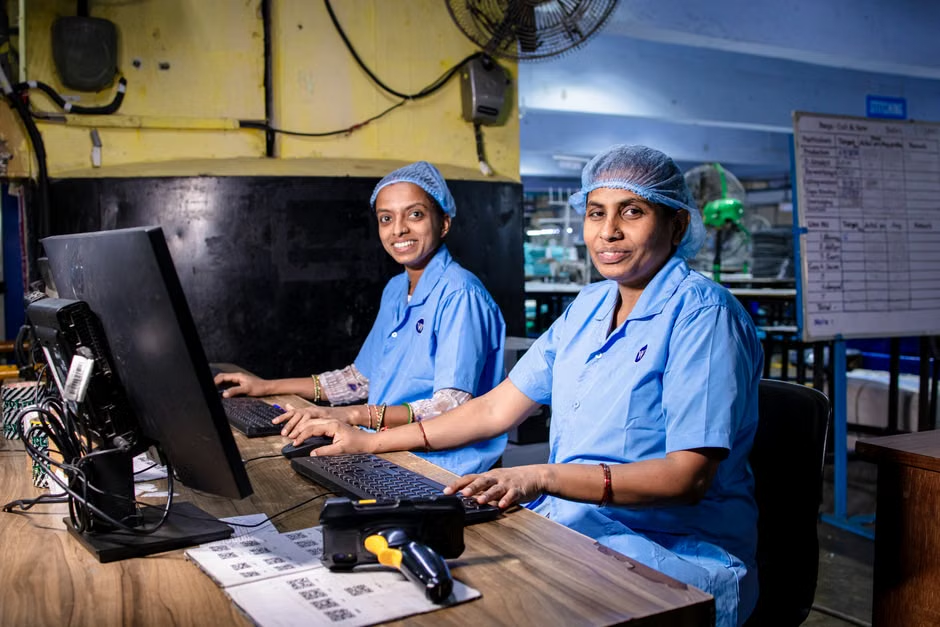
Outsourcing freight data entry to a lower cost market looks like an easy win on the quote. Two contractors in Manila or Taipei at a fraction of the loaded cost of a US ops hire, paid by the house bill, ready to type bookings, master bills, and arrival notices into your forwarding management system. The unit economics seem obvious.
Then the first demurrage invoice lands because someone fat fingered an ETA. The booking number was off by one letter so the container vanished from every carrier tracking portal for three days. A house bill went out with the wrong consignee and customs cleared into the wrong warehouse. Every one of those errors lands back on the desk of the person who thought they were buying capacity, not problems.
This is the math behind a quiet shift among growth stage forwarders in 2026: many are looking at the true cost of offshored freight data entry and concluding that automating the workflow beats hiring more typists, no matter how cheap the typists are. The argument is not ideological. It is arithmetic.
Key Takeaways
- The visible cost of offshored data entry is wage arbitrage. The invisible cost is the rework, demurrage, and margin loss when a single typo escapes the team.
- A single data entry error on an ETA or master bill can cost USD 300 or more per day in demurrage, plus the wiped margin on that shipment.
- Per house bill outsourcing creates an incentive problem. People paid to type fast and cheap will not catch the upstream errors that erase your margin downstream.
- Automation wins when the work is repetitive, structured, and high volume. Headcount still wins for judgment heavy exceptions, broker calls, and customer escalations.
- Run the math: error rate times rework cost times monthly volume. If that number is bigger than the gap between offshore labor and automation, you are paying to import errors.
Why cheaper labor rarely pencils out
Freight data entry looks like the ideal offshoring candidate. The work is documented, repetitive, and English language. The instructions fit on a one page SOP. The training cycle is short. So forwarders default to the classic build: hire a few contractors in a lower cost market, route the bookings and master bills to them, free the US team for sales and customer service.
The flaw is that data entry in freight is not bounded data entry. It is the front of a chain of operational decisions. A wrong booking number means the next person cannot track the container. A wrong ETA means the dispatch team plans the drayage for the wrong day. A wrong commodity code means customs flags the entry. Every keystroke is the input to ten downstream steps, and any single bad keystroke poisons all of them.
One US based forwarder owner put it bluntly during a recent vendor evaluation:
“I do not want anyone to do data entry. It does not matter if labor is cheaper. I have caught so many mistakes that it falls on my plate. The math never works out.
US based forwarder owner, mid market NVOCC, 2026
That comment came after a year of running roughly 500 ocean shipments per month with two offshore contractors handling data entry on a per house bill basis. The owner had spent the prior six months tracking down the errors his own team was catching after the fact. The cost of catching errors, not the cost of typing, was the line that destroyed the business case.
The true cost of one data entry error
To make the math concrete, walk through what one bad keystroke actually costs on a single ocean import shipment.
Suppose the offshore typist enters the ETA as the wrong month. Your ops team sees the container arriving four weeks from now and schedules drayage accordingly. The container actually arrives this week. The carrier discharges it. Your free time at the port starts ticking down. Nobody picks it up because nobody knows it landed.
By the time the customer calls asking why their cargo has not been delivered, the container has been sitting on the terminal for four days. Free time was three days. You are now on day one of demurrage.
| Cost line | Typical range (USD) | Why it lands on you |
|---|---|---|
| Demurrage, 40 ft container | 100 to 300 per day, escalating | Terminal charges accrue once free time expires. |
| Per diem on chassis or container | 40 to 100 per day | Equipment held past the return window. |
| Lost margin on shipment | Full GP on file, often 200 to 800 | Charges absorbed to keep the customer. |
| Rework time, US team | 60 to 180 minutes per incident | Calls to carrier, dispatcher, customer, accounting. |
| Customer relationship hit | Not in this invoice, real in the next renewal | Cumulative misses become a churn trigger. |
A single ETA typo on a single container can wipe USD 1,000 to USD 2,500 of value once you add demurrage, lost margin, and rework. That figure dwarfs the entire monthly cost saving from offshoring one role. You need to find only one or two such errors per month per typist before the savings are gone.
The error that triggered demurrage usually does not surface in your offshore team's QA scorecard. It surfaces in your carrier invoice three weeks later, and by then nobody can reconstruct who typed what. The visible KPI is keystrokes per hour. The invisible KPI is dollars per error. Until you instrument the second one, you cannot price the trade off.
Per house bill outsourcing and the incentive problem
The dominant commercial model for offshored freight data entry is per house bill pricing. You pay a fixed fee, often a few dollars, per HBL processed. It is administratively clean and easy to budget.
The problem is that this model rewards speed and volume, not accuracy. A contractor paid per house bill is incentivized to process as many bills as possible, as quickly as possible. The same forwarder owner quoted above summarized the dynamic:
“We pay by the house. Because the rates are cheaper, people perform cheaper level work, and it is not their fault. That is just how they are incentivized.
US based forwarder owner, mid market NVOCC, 2026
The contractor is not negligent. The contractor is responding rationally to the pricing structure. If quality slips a little, the buyer rarely catches it, and the contractor gets paid for more files. The buyer absorbs the downstream cost of every undetected error.
You can fix this by paying for accuracy instead of volume, by adding QA layers, by sampling files, or by tying compensation to outcome metrics. All of these add cost. Each layer narrows the wage arbitrage that justified offshoring in the first place. At some point you are paying overseas operational management overhead to police overseas data entry, and the spread has closed.
When automation beats headcount, and when it does not
Automation is not a universal answer. It wins decisively for one category of work and loses badly for another. Knowing the line matters.
- Booking creation from carrier confirmation emails or EDI
- Master and house bill data extraction from PDFs
- Status updates from carrier and terminal APIs
- Pre filled customs entries and arrival notices
- Recurring invoice and accrual journal entries
- Exception handling when documents disagree
- Customer escalations and rebooking
- Broker negotiations on demurrage waivers
- Commodity classification on edge cases
- Margin and pricing decisions on bespoke quotes
The work in the left column is structured, repetitive, and high volume. It is exactly where keystrokes turn into dollars of error risk. Modern freight platforms ingest a PDF or carrier email, extract the fields, and write them into the shipment record without a human typing anything. Workflow Automation Software for Forwarders handles document parsing, milestone tracking, and event driven hand offs across the team. The error rate on machine extraction is not zero, but it is bounded, auditable, and improves over time. Human typing error rate is not bounded.
The work in the right column is where experienced forwarders add value. No model handles a freaked out shipper at midnight as well as a person who has been doing this for fifteen years. The right end state is automation for the typing, humans for the judgment, and a forwarding system that puts both in the same operational record.
Accounting is a similar story. Manual posting from your FMS into QuickBooks is the same kind of high volume, low judgment work. Freight Billing & Accounting Software for Forwarders moves invoices, accruals, and agent settlements across modules without rekeying, which removes another long tail of typo driven errors.
A simple cost framework: error rate x rework cost x volume
You can decide whether offshoring or automating is the better economic choice with one formula. The inputs are knowable from your own data.
-
1Measure your true error ratePull the last 90 days of demurrage charges, per diem charges, customer credits, and rebookings. Tag each one with a root cause. Count the share caused by a data entry error upstream. Express it as errors per 100 files. A typical mid market shop lands between 2 and 6 per 100.
-
2Price the average rework costSum the demurrage, per diem, absorbed margin, customer credits, and US team rework hours per incident. Most forwarders find the all in number between USD 600 and USD 1,800 per error event. Use the midpoint as your planning number until you have better data.
-
3Multiply by monthly file volumeError rate per 100 files times rework cost per error times monthly files divided by 100. A shop running 500 files per month at a 3 percent error rate and USD 1,200 per error is carrying USD 18,000 per month of avoidable cost. That is the upper bound on what either offshoring or automation must clear to be worth the trouble.
-
4Compare the two paths honestlyOffshore path: contractor fees minus any savings on US headcount, plus QA layer, plus the new error spend after offshoring. Automation path: software cost, plus the residual human spend, plus the new error spend after automation. Most forwarders past USD 50 million in revenue find the automation path is materially cheaper once the error term is included honestly.
-
5Re run the math every quarterVolume, error rate, and automation capability all move. The decision is not permanent. The framework is. For a deeper operational view on the levers, see GoFreight's guide on how to increase freight forwarding profit margins.
The forwarders who get this right typically arrive at a hybrid model. They automate the repetitive typing through their FMS and document ingestion layer. They keep a small US ops bench for exception handling, customer service, and broker work. They rarely retain a large offshore data entry function once they have run the numbers, because the rework cost line dominates the wage cost line.
If your team is still drowning in email driven coordination on top of all this, the workflow problem is bigger than data entry alone. Our piece on freight workflow management walks through the broader operational reset that usually accompanies the automation decision.
See how GoFreight automates document ingestion, milestone updates, and accounting hand offs so your team stops paying for the rework that offshoring quietly imports.
Request a GoFreight Demo →Frequently asked questions
Is offshoring freight data entry ever the right answer?
Sometimes, for a narrow window. Offshoring can work for high volume, low complexity, low blast radius work where errors are caught instantly and rework costs are small. For most freight forwarding operations, where one bad keystroke triggers demurrage and customer escalation days later, the rework cost dominates the wage savings and the math stops working.
How much does a single data entry error really cost?
A bad ETA or master bill that triggers demurrage typically costs USD 600 to USD 1,800 per incident once you add terminal demurrage, chassis per diem, absorbed margin, customer credits, and US team rework hours. The container demurrage component alone runs USD 100 to USD 300 per day per 40 ft container.
Why does per house bill pricing create quality problems?
Per house bill pricing rewards throughput, not accuracy. A contractor paid by the bill is incentivized to process more files faster. Unless the buyer instruments quality and prices accordingly, the contractor responds rationally to the volume incentive and quality drifts. The buyer absorbs the downstream cost of every error that escapes detection.
Will automation eliminate my back office team?
No. Automation eliminates the typing portion of the back office workload. Judgment heavy work, exception handling, broker calls, customer escalations, commodity classification, and pricing decisions remain human work. Most forwarders who automate end up reallocating their team toward customer experience and higher value operations, not shrinking total headcount.
What kinds of freight data entry are best suited to automation?
Document driven and event driven data entry. Booking creation from carrier confirmations, master and house bill field extraction from PDFs, status milestone updates from carrier and terminal APIs, arrival notice generation, and recurring accounting journal entries. All of these are structured, repetitive, and high volume, which is exactly where automation produces the largest accuracy gains.
How do I calculate the cost of my current data entry errors?
Pull the last 90 days of demurrage charges, per diem charges, customer credits, and rebookings. Tag each one with a root cause and count the share caused by an upstream data entry error. Express it as errors per 100 files, then multiply by your average all in rework cost per error and your monthly file volume. The result is your annual avoidable cost from data entry errors.
What if I cannot automate and cannot afford US headcount?
Start with the highest leverage automation first. Document ingestion and carrier API integration usually pay back inside one quarter for any shop running more than a few hundred files per month. That frees enough US team capacity to absorb the remaining manual work without offshoring. The trap is treating automation and offshoring as either or, when the right answer is often automation first, with a small bench of trained ops people for exceptions.
How fast can I see results from automating data entry?
Most forwarders see measurable reductions in file creation time and demurrage incidents within the first 30 to 60 days of go live. The early wins come from document parsing on master and house bills, automatic milestone updates from carrier APIs, and removing the manual double entry between the FMS and accounting. Error rate improvement compounds over the next two quarters as the team trusts the workflow and stops shadow typing into spreadsheets.
Keep reading
- How Modern Freight Forwarders Track Tasks Without Email Chaos. The operational reset that usually accompanies a decision to automate data entry.
- How to Increase Freight Forwarding Profit Margins. The deeper margin math behind why error reduction beats wage arbitrage.
- 30-Day Freight Software Migration Guide: Week-by-Week Roadmap. Practical playbook for moving off a legacy stack and onto a platform that absorbs the typing.