
AI for Freight Forwarders: Key Takeaways from Our Live Webinar

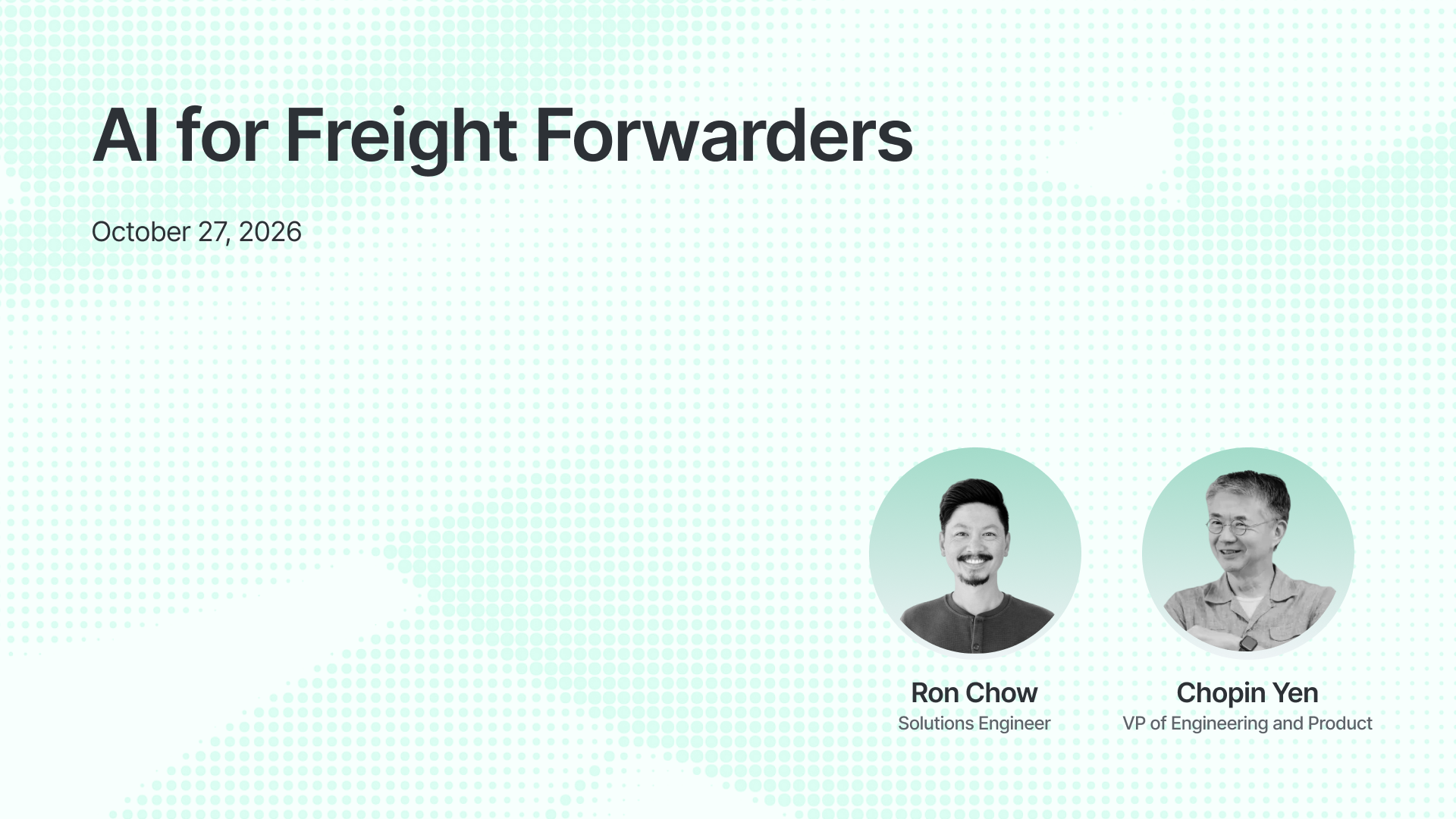
On Tuesday, October 27, Ron Chow (Solutions Engineer) and Chopin Yen (VP of Engineering and Product) spent about an hour with freight forwarders on one question: where does the week actually go, and which of that work should AI take?
Ron has about 15 years in the industry, including 10 at a freight forwarder before GoFreight. Chopin has spent 30 years building solutions, the last five at GoFreight.
Short on time? Here is what mattered.
Nobody got into freight forwarding to retype data
Ron opened with the three places he sees forwarders’ hours go:
- Starting the file. House bills of lading, overseas agent paperwork, export shipments. Someone types it in before the shipment can move.
- The inbox. Pre-alerts, arrival notices, customer questions. Triage never ends.
- Exceptions. When an ETD or ETA changes, someone checks airline sites, ocean carrier sites, truckers and customs portals to find out what happens next.
The data backs it up. Across forwarders on GoFreight, 73.6% of house bills are keyed in by hand. For vendor invoices and debit/credit notes, it’s 90.8%.*
Same tools, different results. The difference is readiness.
Chopin compared two forwarders using the same GoFreight tools on the same documents: bills of lading, invoices, delivery orders. Six months in, one had gotten a lot of its hours back. The other was still doing a lot of typing. He believes the difference is readiness, not the software. Readiness has three parts.
- People. Does someone in your company own AI? Does your team still treat it as a chatbot, or are they thinking about agents that do work?
- Practices. Your shop looks nothing like it did on pencil and paper, and your processes changed each time your tools did. AI is no different. Do you have clear rules for when a shipment moves, pauses or speeds up, and a way to give feedback?
- Systems. Does your system know how you run shipments, invoice customers and handle credits? Can AI agents reach it? Does “shipment” mean the same thing in every system you run, with one reference across all of them?
Chopin used the Model T to make the point. It didn’t win just by being the best car. It was affordable, accessible, durable, and simple enough that owners could maintain it themselves. His test for AI is the same: when it gets something wrong, your ops leader should be able to fix it, not file a ticket and wait.
Sort your work into three buckets
Not everything belongs to AI. Chopin sorts work three ways:
- AI: reading and retyping. It can read an inbox all day and match each email to the right shipment.
- Rules: clear logical rules. When a carrier changes an ETD and an AES file already exists, the file needs updating. Your ops team shouldn’t have to remember that across 50 to 100 shipments at once. Your system should handle it and remind them.
- People: judgment and relationships. What a customer cares about but never says out loud. Which carrier to call when a booking rolls.
Then start with what Chopin calls your “Goldilocks” process: one that matters to the business, but isn’t the most critical thing you run. His example is turning inbound email into shipment updates.
AI will get things wrong. Teach it like a new hire.
A question Chopin gets a lot: do we have to write every SOP before we start? No. Start with the list you already carry in your head. Have your system watch how your best operator works, let AI draft the playbook, then correct it as you go. What matters is whether the fix sticks, so you aren’t teaching the same lesson again and again. You should also be able to see who changed a record, when and how, in seconds, without launching an investigation.
Plan the time, too. Spend one-on-one time with your AI agent the way you would with a junior hire. The more you put in early, the faster the payoff.
AI readiness is an operations skill
In the system-of-record era, IT owned the system, or you paid a consultant to tune it. Chopin’s point is that ownership has moved. The person who knows what the right answer is, your operations lead, can own it now. That makes AI readiness an operations management skill, and it fits what new operators want: less data entry.
Five questions to ask any AI vendor, including us
- Is it native or bolted on? If you end up copying answers from a chat window back into your TMS, you’ve bought a second place to type.
- Can I see it learn? Ask for a demo of how the agent learns, not just what it does.
- Can my team teach it? Is there a screen where ops can review its work and correct it, or are there layers between you and the fix?
- How much time will it take, and how fast does it ramp? Know what you’re signing up to teach.
- What does it do when it isn’t sure? A confident wrong answer looks exactly like a right one, and it travels through your system.
From the Q&A
- Can an agent work from email? Chopin said yes, and that some GoFreight customers already run it. The agent reads a connected inbox, follows rules the customer sets, updates the shipment, and can trigger other workflows, some rule-based and some AI, such as arrival notices.
- How do I get started or see a demo? Existing customers can reach out to customer success. If you’re new to GoFreight, talk to us.
- What does it cost? “It depends,” Chopin said. His standard: it has to work, be affordable, and keep your data secure and private. If you tell Ron which workflows you’re looking at, he can walk through them with you.
- Will there be a beginner-level session with live demos? One attendee asked. Chopin and Ron both said they’d like to put one together.
We also ran a poll: if you won 200 more loads tomorrow, what’s your first move? A) hire more operators, B) write down how you do it and train them, C) fix how shipments enter your system, or D) put AI on the repetitive steps. Plenty of attendees picked D.
Where do you stand?
Ron’s closing point: AI doesn’t replace freight forwarders. It’s an assistant that takes the typing and the mundane work off their plate. Chopin added that every forwarder runs a little differently, and you know your operations best.
Our FAIR scorecard is a good place to start. It’s twelve questions across people, practices and processes, and systems, with next moves for wherever you land. Take the FAIR scorecard
Want to see GoFreight’s AI agents on your own workflows? Book a demo
Already a customer? Reach out to your customer success team.


